Somewhere between "I'd like to retire one day" and "I want to retire at 45" sits a single number. It's the amount of invested wealth you'd need for your portfolio to fund your life indefinitely, without you ever having to earn another pound. The FIRE community calls it your FIRE number.
Most of what's written about FIRE is American. That's a problem, because the UK has State Pensions, ISAs, SIPPs, and a very different property market, and the US frameworks don't translate cleanly. This guide fixes that.
If you've ever wondered where the finish line actually is, this is how to work it out.
What a FIRE number actually is
FIRE stands for Financial Independence, Retire Early. Your FIRE number is the size your portfolio needs to reach so that its returns, on average over decades, can cover your spending forever.
The basic formula is simple:
Annual spending × 25 = FIRE number
If you spend £30,000 a year, your FIRE number is £750,000. If you spend £50,000, it's £1.25 million. The multiplier of 25 comes from the 4% rule: withdraw 4% of your portfolio in year one, adjust for inflation thereafter, and the money has historically lasted at least 30 years.
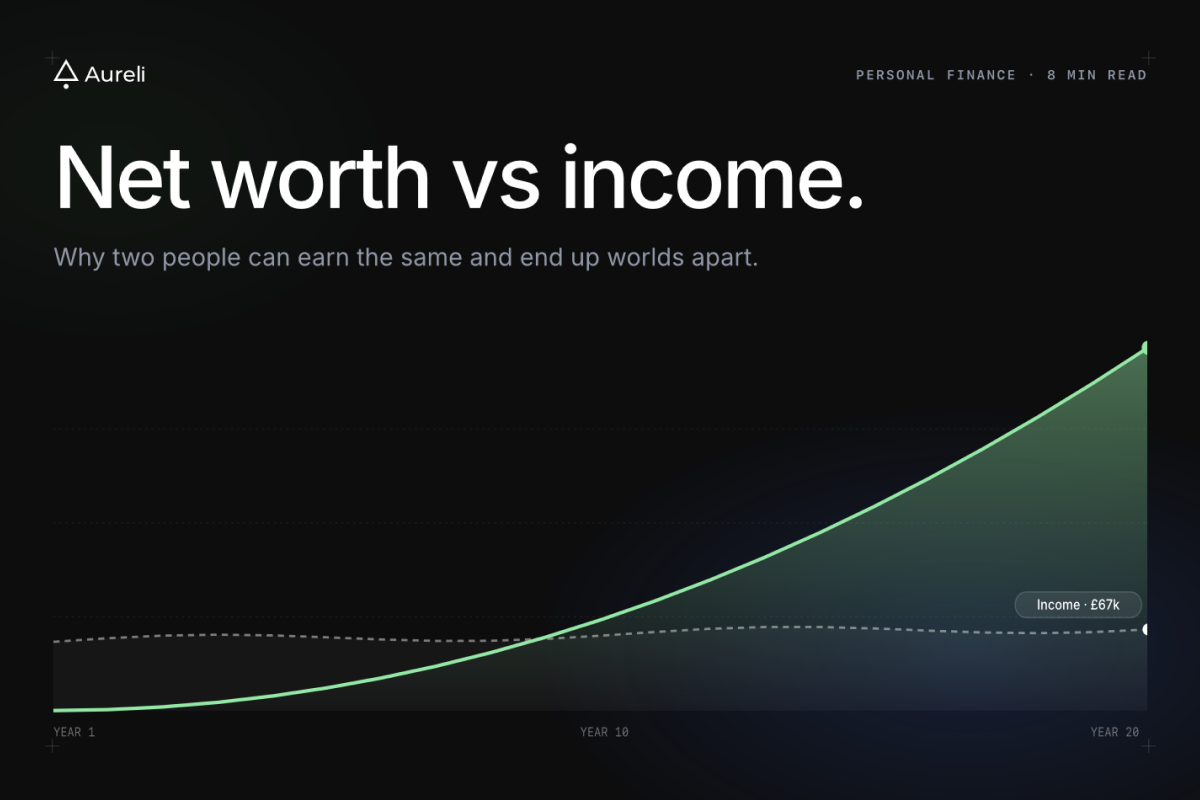
Notice what the formula ignores. It doesn't ask what you earn. It doesn't ask how old you are. It doesn't care about your industry or your job title. FIRE is a net worth game, not a budgeting exercise, and that's why it lines up so neatly with the habit of tracking your net worth. Your savings rate, your investment returns, your debt reduction and your property equity all eventually roll up into the same line on the same dashboard.
The 4% rule, and why UK savers often adjust it down
The 4% rule comes from two pieces of US research: William Bengen's 1994 paper on safe withdrawal rates, and the 1998 Trinity Study. Both used US historical market data and looked at 30-year retirements. For a 65-year-old American retiring in 1995, 4% was a reasonable assumption.
For a 40-year-old Brit retiring in the 2030s, it's a starting point, not gospel. A few reasons UK FIRE planners tend to use 3% to 3.5% instead:
- Longer horizon. Retiring at 40 means you might need the portfolio to last 50 years, not 30. The maths gets harder the further out you go.
- Different market history. UK equity returns have historically been slightly lower than US returns, and global diversification changes the picture again.
- Sequence of returns risk. A bad run in your first few years of retirement does disproportionate damage. The lower your withdrawal rate, the more resilient you are to this.
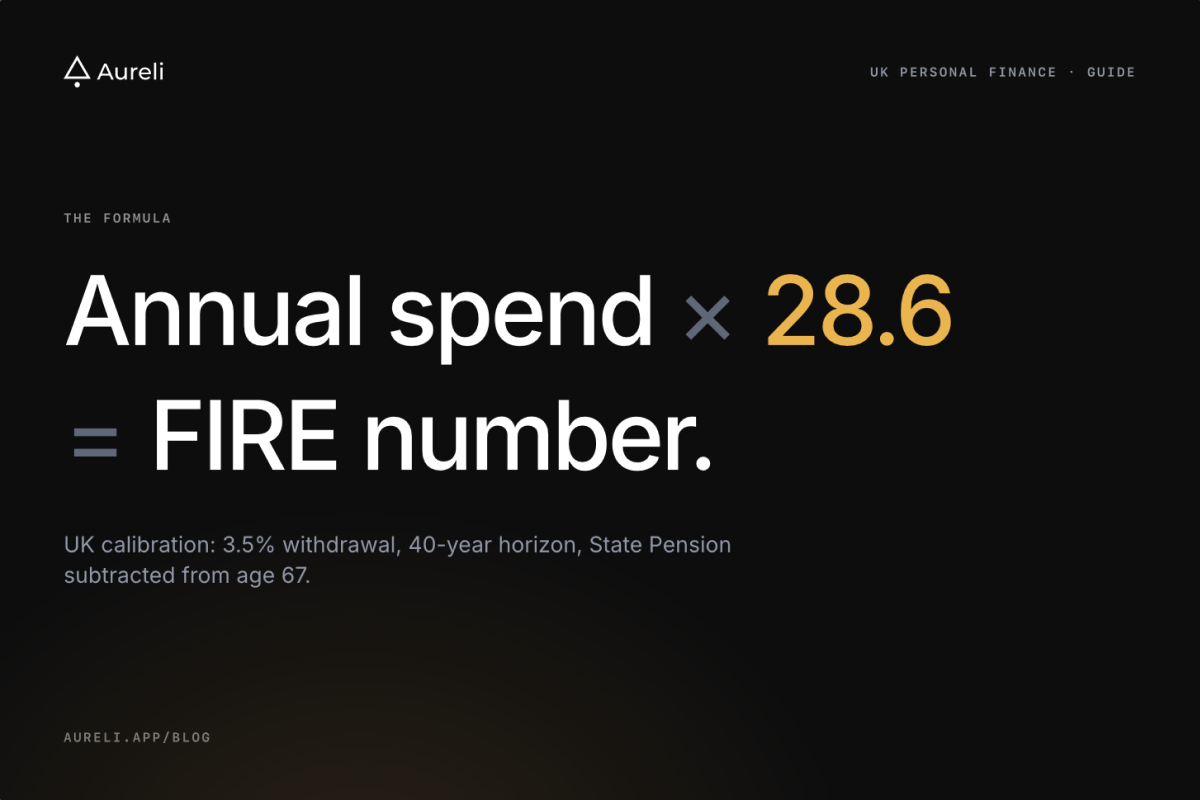
The impact on your FIRE number is meaningful. At a 4% withdrawal rate, £30,000 of spending needs £750,000. At 3.5%, the same spending needs roughly £857,000. At 3%, it's £1 million. None of these numbers is objectively correct. Pick one that matches how cautious you want to be, and understand the trade-off: a lower withdrawal rate means more savings needed but more safety; a higher rate means reaching the goal sooner but thinner margins if markets misbehave.
The different types of FIRE: Lean, Fat, Coast, and more
FIRE is a spectrum, not a single destination. The community has evolved useful labels for where people sit along it.
Lean FIRE is built around genuinely frugal living, typically £15,000 to £20,000 a year in spending, with a target portfolio of £375,000 to £500,000. It's the fastest route to financial independence, but it requires sustained discipline and a lifestyle many people wouldn't want long-term.
Standard FIRE is the middle ground. Annual spending of around £30,000 to £40,000, a target somewhere between £750,000 and £1 million. Comfortable rather than austere. This is what most people mean when they say "FIRE."
Fat FIRE is premium-lifestyle financial independence, £50,000 a year and up, with targets starting at £1.25 million and going considerably higher. It usually requires high income during the accumulation phase, a longer runway, or both.
Coast FIRE is a different concept. You've saved enough that compound growth alone will carry you to a full FIRE number by traditional retirement age, with no further contributions. You still work, perhaps part-time or in something lower-stress (sometimes called Barista FIRE), but only to cover current spending. The saving is done. For many people, this is the more realistic milestone to aim at.
None of these is better than the others. They're different answers to the same question: how much portfolio, relative to how much lifestyle, do you want before you stop exchanging time for money?
UK-specific considerations that US FIRE content misses
This is where the generic American content falls apart.
The State Pension reduces your FIRE number
The full new State Pension is £11,973 a year for the 2025/26 tax year, rerated each April by the triple lock. For a couple with full entitlements, that's close to £24,000 a year of inflation-linked, guaranteed income from State Pension age.
That income reduces the size of the portfolio you need. If you and your partner will receive £24,000 a year between you, and you plan to spend £40,000 a year in total, only £16,000 of that has to come from your portfolio once State Pension kicks in. At a 3.5% withdrawal rate, £16,000 × 28.6 is roughly £458,000, rather than the £1.14 million you'd need if you were self-funding the whole £40,000.
There's a catch. You can't access the State Pension until State Pension age, currently 66 and rising to 67 between 2026 and 2028. If you're retiring at 45, that's 21 years your portfolio has to bridge.
Private pensions have an access age too
Private pensions (SIPPs, workplace DC schemes) can't be accessed until age 55. That's rising to 57 on 6 April 2028. If you retire early, the portion of your wealth that sits inside a pension wrapper is locked up until then.
This is the single biggest mistake people make when planning UK FIRE. They add up their total invested wealth, compare it to their FIRE number, and assume they're done. But if £400,000 of that £800,000 is in a pension and you're 42, you can't actually spend it for more than a decade. Your early-retirement years need a different bucket.
ISAs are the bridge
This is where ISAs, specifically Stocks and Shares ISAs, earn their place in a UK FIRE plan. Contributions come from already-taxed income, but growth is tax-free and withdrawals are tax-free at any age. No lock-up. The £20,000 annual allowance is generous enough that a committed saver can build a substantial bridge fund over a decade or two.
A workable UK FIRE structure often looks like this: build your ISA to cover the years between early retirement and age 57, then let your pension do the heavy lifting once you can access it, with the State Pension coming online on top of both later. It's the sequencing that matters, not just the total.
If you're still weighing up which wrapper to feed first, we've written a full guide on ISA vs pension decisions.
Property equity is real wealth but not spendable income
Many UK FIRE seekers have significant wealth tied up in property, and property equity absolutely belongs in your net worth. But it doesn't generate income unless you downsize, remortgage, or rent out rooms. A paid-off £500,000 flat is a good thing to own, but it won't pay your energy bill.
When you're calculating your FIRE number specifically, it's usually cleaner to treat your main home as separate from your investable portfolio. Include it in your overall net worth, exclude it from the 25× multiplier. If you plan to downsize in retirement, the cash released becomes part of your portfolio at that point, but not before.
US tax tricks don't work here
A lot of American FIRE content leans heavily on Roth IRA conversions, 72(t) distributions, and 401(k) rollover ladders. None of these exist in the UK. The UK equivalents, ISAs and SIPPs, have their own rules, their own allowances, and their own access ages. Copying an American plan without translating it leads to plans that simply don't work.
How to calculate your personal FIRE number
A practical way to do it.
1. Work out your real annual spending. Not what you earn. What you actually spend. Go back 12 months of statements if you have them. Be honest about the things you'd still spend on in early retirement (food, housing, travel, hobbies) and the things you wouldn't (commuting, work clothes, maybe certain subscriptions).
2. Decide your withdrawal rate. 4% is the historic baseline. 3.5% is sensible for an early retiree planning a 40+ year horizon. 3% is conservative. There's no right answer. Pick one and know why you picked it.
3. Multiply. Annual spending ÷ withdrawal rate = FIRE number. (Dividing by 0.04 is the same as multiplying by 25; dividing by 0.035 is the same as multiplying by 28.6.)
4. Subtract guaranteed future income, carefully. State Pension, defined benefit pensions, inflation-linked annuities. These reduce the portfolio you need, but only from the point at which they start. Model them as reducing your withdrawal needs from State Pension age onwards, not from day one.
5. Know your current net worth. The gap between where you are now and your FIRE number is the journey. Calculating net worth properly, including pensions, investments, property equity, and debts, is the single most useful thing you can do to orient yourself.
A worked example
Meet Priya. She's 32, earns £55,000, and spends £32,000 a year. She has a workplace pension with roughly £45,000 in it, a Stocks and Shares ISA worth £28,000, and a flat worth £320,000 with a £230,000 mortgage, giving her £90,000 of property equity.
Her FIRE number at a 3.5% withdrawal rate is £32,000 × 28.6, or roughly £915,000.
She expects a full State Pension of around £12,000 a year from age 67 (in today's money). Once that kicks in, only £20,000 of her spending needs to come from her portfolio. Her post-State-Pension FIRE number becomes £20,000 × 28.6, or roughly £572,000.
Her current invested net worth (excluding her main home) is £45,000 + £28,000, or £73,000. She's well on her way, but her plan needs to think in two phases: build an ISA large enough to bridge from whenever she stops work to 57, then let the pension cover 57 to 67, then let the State Pension take some of the load from 67 onwards. Same destination, different buckets, different timelines.
This is the kind of picture a spreadsheet can start to show but a net worth dashboard makes much easier to keep track of month to month.
Why tracking your net worth is the key FIRE habit
A FIRE number is static for a while. Your net worth isn't. It moves every month with your savings, your investments, your property valuation, and your debts. The distance between the two is the only thing that really matters, and the only way to know the distance is to measure it honestly.
Once you know both numbers, the ratio between them is your FIRE percentage: current invested net worth divided by FIRE number, expressed as a percentage. 18% today, 22% this time next year, 40% five years in. Watching it climb is the whole game. It turns a distant abstract goal into a single number that moves in the right direction every time your savings rate holds and markets cooperate.
People who reach FIRE tend to share one boring habit: they look at their numbers regularly. Not obsessively, not daily, but often enough to notice trends, catch mistakes, and feel the progress. That habit is exactly what a net worth tracker is for, and it's one of the financial milestones worth paying attention to in its own right.
Aureli was built for this. Pensions, ISAs, GIAs, bank accounts, property equity, stocks, cash, debts, all in one dashboard, in your currency, updated when you want it to be. No budgets. No spending categories. Just the single number that tells you how close you are.
Common mistakes UK FIRE seekers make
Ignoring pension wealth. Your pension is probably your biggest asset. Count it.
Counting gross property value instead of equity. A £400,000 flat with a £280,000 mortgage is £120,000 of wealth, not £400,000.
Ignoring the access-age gap. A plan that's fully funded on paper but locked up until 57 isn't funded. It's a bridging problem waiting to happen.
Using US withdrawal-rate assumptions blindly. 4% is an American number for a 30-year retirement. UK early retirees often land between 3% and 3.5%.
Treating FIRE as a finish line. It's a direction. Most people who hit the number change how they work rather than stopping outright.
Forgetting that spending drives everything. Your FIRE number is a multiple of what you spend, not what you earn. Net worth matters more than income, and spending matters more than both.
The first step is knowing where you stand
Your FIRE number is personal. It depends on your spending, your risk tolerance, your pension arrangements, your partner's finances, and the life you actually want to live. Two people on identical salaries can have FIRE numbers £500,000 apart, and both can be right.
What isn't personal is the starting point. Before you can plan the journey, you need to know where you are. That means a real net worth calculation: every asset, every debt, every pension, every ISA, counted once and counted properly.
Do that, pick a withdrawal rate, subtract what you expect from the State Pension, and you have your number. From there it's a matter of saving, investing, and checking in often enough to stay honest with yourself.
Sources
- Department for Work and Pensions, State Pension rates. See gov.uk for the current year's figures.
- HMRC, ISA subscription limits. See gov.uk for the current annual allowance.
- Finance Act 2022, minimum pension access age rising from 55 to 57 on 6 April 2028.
- Pensions Act 2014, State Pension age timetable (66 to 67 phased in between 2026 and 2028).
- William P. Bengen, "Determining Withdrawal Rates Using Historical Data," Journal of Financial Planning, 1994.
- Cooley, Hubbard and Walz, "Retirement Savings: Choosing a Withdrawal Rate That Is Sustainable" (the Trinity Study), 1998.
- Office for National Statistics, Wealth and Assets Survey, Round 8 (April 2020 to March 2022), published January 2024.
Want to see where you stand? Aureli lets you track all your assets, debts, pensions, and property in one place, free to get started.