Tuesday, March 10, 2026
Net Worth vs Income: Why Your Salary Doesn't Tell the Full Story

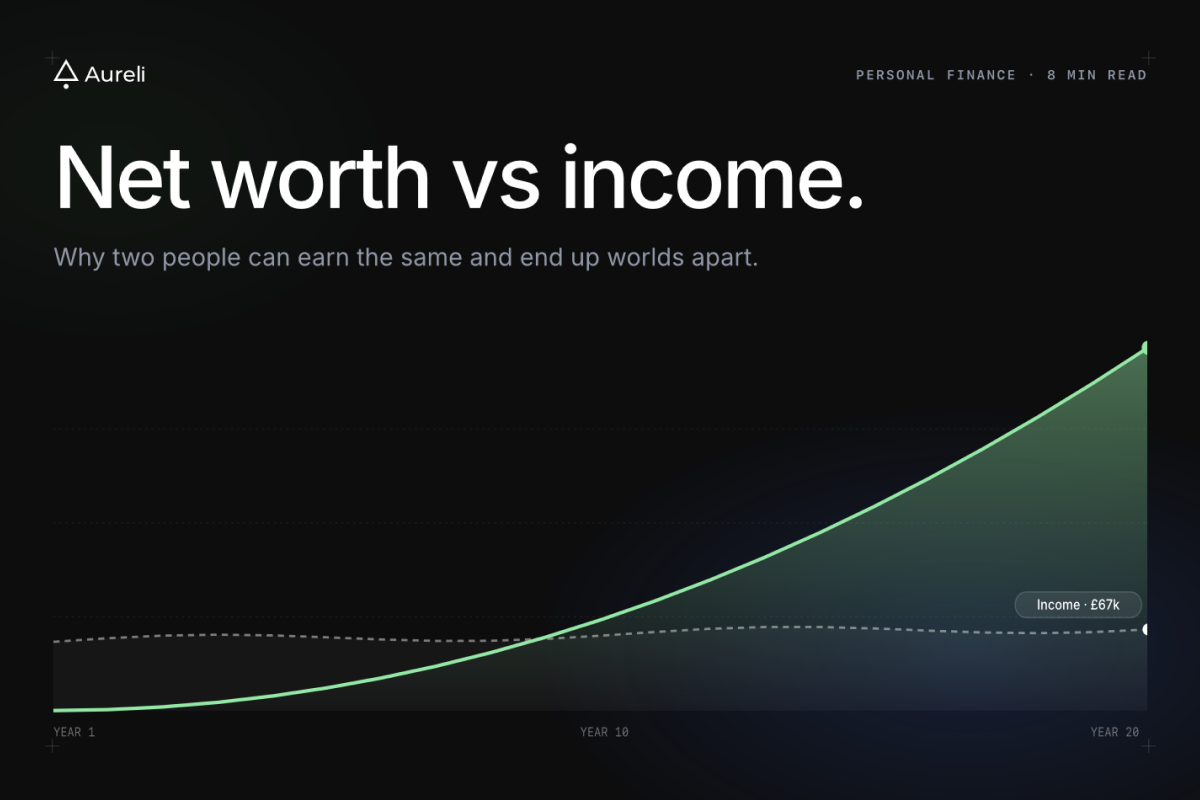
If someone asked you how you're doing financially, you'd probably talk about your salary. Maybe your bonus, or a recent pay rise. Income is the number most people reach for when they think about financial health — and it makes sense. It's tangible, it's regular, and it's the thing that hits your bank account every month.
But income is a flow. It tells you how much water is pouring into the bucket. It says nothing about how much is in the bucket — or whether the bucket has holes.
That's the difference between income and net worth. And understanding it can completely change how you think about money.
What net worth actually is
Net worth is everything you own minus everything you owe. Your savings, investments, pension, property equity, and any other assets — minus your mortgage, student loans, credit cards, car finance, and other debts.
It's one number that captures your entire financial position. Not what you earn, not what you spend, but what you've actually accumulated.
| Income | Net Worth | |
|---|---|---|
| What it measures | How much you earn | What you've built |
| Time frame | Monthly or annual | Cumulative, lifetime |
| Affected by | Employer, role, market | Saving, investing, debt repayment |
| Can be negative? | No | Yes |
| Tells you about | Earning power | Financial security |
Why high earners can have low net worth
This is the part that surprises people. You can earn a six-figure salary and still have a net worth close to zero — or even negative.
It happens more often than you'd think:
- Lifestyle inflation: As income rises, spending rises to match. A bigger flat, nicer car, more holidays. The surplus that could be building wealth gets absorbed.
- Debt-funded lifestyle: High earners often carry significant debt — large mortgages relative to equity, car finance, credit cards used for convenience but not fully cleared.
- Late start on investing: Someone who earned £30,000 and invested consistently from age 25 can easily outpace someone who earned £80,000 but didn't start investing until 40.
- Ignoring pensions: If your employer offers pension matching and you're not taking full advantage, you're leaving free money — and decades of compound growth — on the table.
The uncomfortable truth is that income creates the potential for wealth, but it doesn't create wealth on its own. That requires the gap between what you earn and what you spend to be directed somewhere productive.
Why modest earners can build surprising wealth
On the other side, people on average salaries regularly build impressive net worth. The common thread is almost always the same: they spend less than they earn, and they do it consistently over a long period.
A few things tend to be true of people who build wealth on modest incomes:
- They bought property earlier (even a small flat), and time did the heavy lifting on equity
- They contribute to their pension and benefit from employer matching and tax relief
- They avoid high-interest debt or pay it off aggressively when they do take it on
- They invest regularly, even small amounts, into index funds or ISAs
None of this requires a high salary. It requires a positive gap between income and spending, and the discipline to direct that gap into assets rather than consumption.
The net worth formula is simple — the inputs aren't
Calculating net worth is straightforward: assets minus debts. But the inputs can be spread across a dozen different accounts, currencies, and providers.
Assets you might have:
- Current and savings accounts
- Stocks and shares ISAs
- Workplace and personal pensions
- Property (market value, not purchase price)
- Investment platforms (funds, ETFs, individual stocks)
- Crypto holdings
- Cash ISAs
- Premium bonds
Debts you might have:
- Mortgage (remaining balance)
- Student loans
- Credit cards
- Personal loans
- Car finance (PCP, HP, or loan)
- Buy now, pay later balances
- Overdrafts
The challenge isn't the maths — it's gathering the data. Which is why most people who try to calculate their net worth do it once, find it tedious, and don't come back to it for months.
Income matters — but it's a means, not the measure
None of this is to say income doesn't matter. Of course it does. Higher income gives you more room to save, invest, and pay down debt. Negotiating a pay rise or switching to a better-paying role is one of the most impactful financial moves you can make.
But income is a tool. Net worth is the scoreboard.
Consider two people at age 45:
Person A earns £95,000 a year. They rent a flat in London, have £15,000 in savings, £8,000 on credit cards, a car on PCP, and a pension they've never really looked at. Net worth: roughly £40,000.
Person B earns £48,000 a year. They bought a two-bed house in the Midlands eight years ago, overpay their mortgage by £150 a month, max out their ISA allowance, and have been contributing 8% to their pension since their mid-20s. Net worth: roughly £280,000.
Person A has almost double the income. Person B has seven times the net worth. Both are real patterns that play out across the UK every day.
What about property?
In the UK especially, property is often the single largest component of someone's net worth. But it's easy to get confused about what it actually contributes.
If your home is worth £350,000 and you owe £280,000 on the mortgage, your property adds £70,000 to your net worth — not £350,000. Your equity is what counts.
This is why linking your mortgage to your property value is so important when tracking net worth. Seeing the true equity figure — and watching it grow as you make repayments and the property appreciates — is one of the most motivating parts of net worth tracking.
When does net worth matter most?
Income matters most during your working years. It's the engine that powers everything else. But net worth matters most when:
- You want to retire: Your pension, ISAs, and savings need to sustain you, not your salary
- You face an emergency: A job loss, health issue, or unexpected expense — your net worth determines your resilience
- You want financial freedom: The point where your assets generate enough to cover your expenses, whether or not you work
- You're making big decisions: Buying a home, starting a business, taking a career break — these are net worth questions, not income questions
The ultimate goal for most people is to reach a point where their net worth works for them. Where investment returns, pension income, and savings mean they're no longer dependent on a salary. That's something income alone can never achieve.
How to start thinking in net worth terms
If you've been focused on income your whole life, shifting to a net worth mindset takes a small but meaningful change in perspective:
- Calculate your net worth today. Even a rough estimate is fine. Just get the number.
- Track it monthly. Pick a day and spend ten minutes updating it. The trend matters more than precision.
- Focus on the gap. The difference between your income and your spending is the raw material for building wealth. Widen it where you can.
- Direct the gap into assets. Savings, pension contributions, ISA investments, mortgage overpayments — anything that grows your net worth.
- Review quarterly. Step back every few months and look at the trajectory. Are you heading in the right direction?
The shift from "how much do I earn?" to "how much have I built?" is one of the most powerful mental models in personal finance. Your salary is what someone else decides to pay you. Your net worth is what you've done with it.
Want to see your full financial picture in one place? Aureli lets you track all your assets and debts — including property equity, pensions, and investments — so you always know your real net worth.