Sunday, April 19, 2026
The £100k Tax Trap: How the 60% Effective Rate Works (and How to Escape It)

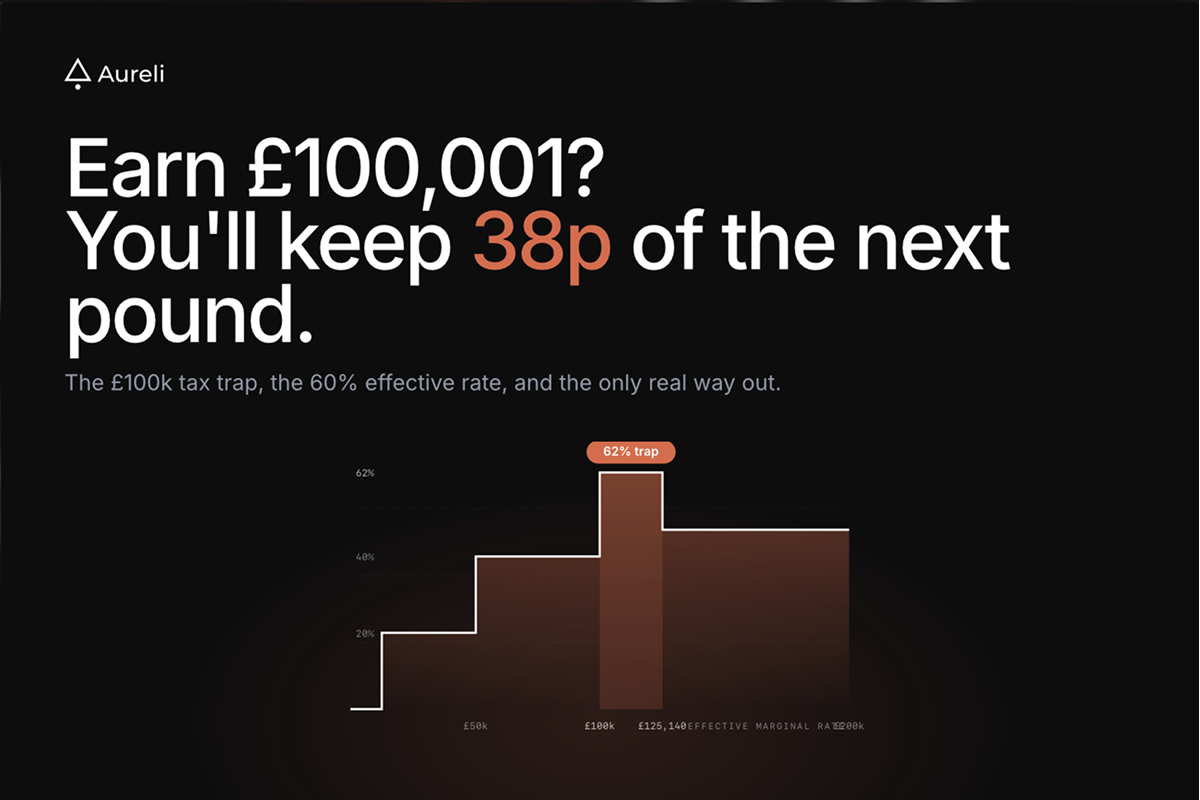
Every pound you earn between £100,000 and £125,140 is taxed at roughly 60p. A pay rise from £100,000 to £110,000 leaves you with about £3,800 of the £10,000. This is not a loophole, not an HMRC error, and not a rumour. It's the way the Personal Allowance taper was designed when it was introduced in 2010.
It has also, quietly, become the single biggest financial decision point for UK high earners. HMRC now expects more than 2 million people to be caught by it in the 2026/27 tax year, the highest number on record. If you're anywhere near the threshold, understanding it properly is worth far more than reading another article about index funds.
What the £100k tax trap actually is
The trap is a mechanical feature of the UK income tax system. Above £100,000 of adjusted net income, your £12,570 Personal Allowance is withdrawn at a rate of £1 for every £2 you earn, until it disappears entirely at £125,140.
That withdrawal doesn't show up on a payslip as a separate line. Instead, income that would have been tax-free becomes taxable, and because you're already in the 40% higher-rate band, every £2 of lost allowance costs you an extra 80p of tax. Layered on top of the 40% you're already paying, the marginal rate on earnings in the £100k–£125,140 band works out at 60%, and 62% once the 2% employee National Insurance above the Upper Earnings Limit is added in.
Different sources round it differently. 60% is the clean income-tax-only figure. 62% is the fully loaded rate including NI. Both are right. What matters is that the effective tax bill on the next pound of salary is closer to additional-rate territory than higher-rate territory, despite being legally "higher rate."
Above £125,140, the marginal rate drops again, counterintuitively, because there's no more Personal Allowance left to withdraw. The additional rate (45%) plus 2% NI is 47%, meaningfully lower than the 62% people pay in the band just below it.
Why 2026/27 is the worst year on record for the trap
The £100,000 threshold has not moved since April 2010. Average UK earnings have roughly doubled since then. That's textbook fiscal drag: freeze a threshold, let inflation pull more people across it each year, and collect more tax without ever legislating a rate rise.
HMRC's own forecasts put over 2 million taxpayers inside the £100k–£125,140 band in the 2026/27 tax year. Five years ago the figure was roughly half that. The population affected has grown faster than almost any other group in the tax system.
If you've recently started a new tax year and want to think about where your allowances stand, our new UK tax year checklist for 2026/27 is a useful companion to this post. Several of the moves below only work cleanly if you do them early in the year.
A worked example: Ade's £8,000 bonus
Meet Ade. He earns £102,000 a year and has just been told his performance bonus for the year is £8,000, taking his total income to £110,000. He has no children. He does not currently make pension contributions beyond the workplace default.
Here's what happens to that extra £10,000 of income (£2,000 from crossing into the band on his base salary, plus his £8,000 bonus).
- All £10,000 sits in the 40% higher-rate band, so £4,000 goes to income tax.
- It also sits above the NI Upper Earnings Limit, so an extra 2% (£200) goes to National Insurance.
- Because the £10,000 is above £100,000, it withdraws £5,000 of his Personal Allowance. That £5,000 of previously tax-free income now gets taxed at 40%, which is an additional £2,000 of income tax.
Total tax and NI on the £10,000 slice: £6,200. Take-home: £3,800. The effective marginal rate is 62%.
Now imagine Ade uses salary sacrifice to redirect the entire £10,000 into his workplace pension, bringing his adjusted net income back to exactly £100,000.
- His Personal Allowance is fully restored.
- He saves the £6,200 of tax and NI he would otherwise have paid.
- The £10,000 lands in his pension at an effective cost of £3,800, the same figure as his would-be take-home.
- His employer also saves 15% employer NI on the sacrificed amount, worth £1,500. Some employers pass this on into the pension; many don't. Always check the policy in writing before assuming.
If his employer passes on the full NI saving, Ade converts a £3,800 take-home decision into an £11,500 pension contribution. That is a genuinely unusual return for a single line on a payroll form, and it exists only because of the specific shape of the tax system in this band.
The escape route: pension contributions and adjusted net income
The £100k threshold is measured against adjusted net income, not gross salary. Pension contributions made by salary sacrifice reduce your adjusted net income pound-for-pound. Personal pension contributions made via relief-at-source also reduce it, via the gross amount contributed.
Both routes get you out of the trap. They work slightly differently.
Salary sacrifice is the cleanest. You agree with your employer to reduce your contractual salary by, say, £10,000, and they pay that £10,000 into your pension. Because the £10,000 never counts as your income, you save both income tax and NI on it. The employer also saves their 15% NI, which some employers share.
Relief at source is how most personal SIPP and stakeholder contributions work. You pay in from already-taxed income; the provider automatically adds 20% basic-rate relief; you then claim the extra 20% as a higher-rate taxpayer, or 25% as an additional-rate taxpayer, through self-assessment. If you're inside the £100k taper band, the same gross contribution also restores some or all of your Personal Allowance, which is worth up to a further 20p per pound on the affected slice. That is what produces the ~60% effective relief in this band. The tax relief works out roughly equivalent to salary sacrifice in income tax terms, but you don't get the NI saving. The higher-rate reclaim and the Personal Allowance recovery are not applied automatically. You must file a return. A significant number of higher-rate taxpayers under-claim this every year.
The annual pension allowance for most people is £60,000 in 2026/27. If you haven't used all of last year's allowance, or the two years before that, you can carry forward the unused portion, provided you were a member of a registered pension scheme in those years. For anyone catching up after years of lower contributions, carry forward can absorb a large bonus or equity payout in a single tax year. For very high earners with adjusted income above £260,000 the allowance tapers, down to a minimum of £10,000; most readers of this post won't be affected, but it's worth knowing the ceiling exists.
For anyone weighing up pension contributions against topping up a Stocks and Shares ISA once they're back under £100k, our ISA vs pension guide sets out the trade-offs. Above the trap, the answer is almost always "pension first, by a wide margin." Below it, the calculus changes.
Other ways to reduce adjusted net income
Pensions do the heavy lifting, but a few other things also reduce adjusted net income and can help at the margins:
- Gift Aid donations. The grossed-up amount of Gift Aid contributions reduces adjusted net income. £80 donated becomes £100 grossed up, and that £100 comes off the figure HMRC uses for the taper.
- Electric vehicle salary sacrifice. The Benefit-in-Kind rate on fully electric cars is 3% in 2026/27, rising to 4% from 6 April 2027. A sacrifice scheme moves the lease cost out of gross salary and replaces it with a small BiK charge, which can shift several thousand pounds of adjusted net income depending on the vehicle.
- Cycle-to-work schemes. Smaller in absolute terms, but they work the same way: pre-tax deductions that reduce the income figure the taper is calculated against.
None of these are substitutes for a pension contribution when you're staring at a 60% marginal rate. They're useful layers to stack on top.
The triple hit if you have children
If Ade had a one-year-old, the picture would look meaningfully worse, because the £100,000 threshold is a cliff edge for several benefits that disappear the moment you cross it.
Tax-Free Childcare pays 20p for every 80p you pay into a qualifying childcare account, up to £2,000 per child per year (£4,000 for a disabled child). Eligibility stops completely if either parent has adjusted net income above £100,000. Not tapered. A cliff.
30 hours of free childcare for three- and four-year-olds (and the newer extended hours for younger children) uses the same £100,000 threshold, and the same cliff-edge rule. A parent nudged from £99,500 to £100,500 can lose thousands of pounds of childcare support for the year.
High Income Child Benefit Charge. Since April 2024, the charge starts at £60,000 of adjusted net income and fully claws the benefit back at £80,000. A family with two children receives £26.05 a week for the first and £17.25 for each additional child in 2025/26. Across a year, Child Benefit for two children is worth a little over £2,200; losing it via HICBC between £60k and £80k is effectively an additional marginal tax rate layered on top of the standard one.
For a parent earning £110,000 with young children in nursery, the effective hit on the £10,000 bonus isn't 62%. It's 62% plus lost childcare worth potentially £2,000 per child plus the value of the 30 free hours (often £7,000+ a child in London). In the worst real-world cases, the bonus can leave the household meaningfully worse off once childcare costs are re-priced at the unsubsidised rate.
This is the single most common reason HENRY parents sacrifice aggressively into pensions. Not the pension growth. The childcare.
The closing window: salary sacrifice NI changes from April 2029
At the Autumn Budget 2025, the Chancellor announced that from 6 April 2029, only the first £2,000 per year of pension contributions made by salary sacrifice will remain exempt from employee and employer National Insurance. Contributions above that will still receive full income tax relief, but will no longer save NI.
It's worth framing that change accurately. Salary sacrifice is not being abolished. Large sacrifices above £2,000 will still be highly tax-efficient. Income tax relief alone at a 60% effective marginal rate is still, by a wide margin, the best return on a pound of income available to a UK earner. What changes is that the extra icing of NI relief disappears for everything above £2,000.
The practical implication: the 2026/27, 2027/28, and 2028/29 tax years are the last three full years of fully NI-efficient large sacrifices. Anyone planning a catch-up contribution using carry-forward allowance, or redirecting a bonus that would otherwise sit in the 60% band, has a finite window to do so at maximum efficiency. After April 2029, the same contribution still saves tax, just slightly less of it.
Things worth knowing before you sacrifice a lot
A few practical points people learn the hard way.
Mortgage affordability. Lenders calculate affordability on your post-sacrifice salary, not your pre-sacrifice figure. If you're planning to apply for a mortgage in the next 6–12 months, time any large sacrifice changes carefully, or confirm in writing with your lender how they treat pension contributions. Some treat a portion of sacrifice as add-backable; most don't.
Statutory pay. Statutory Maternity Pay, Statutory Sick Pay, and statutory redundancy pay are generally calculated on post-sacrifice salary. If you're thinking about starting a family or there's a plausible restructuring risk, the downside here is real and worth modelling.
National Minimum Wage. You can't sacrifice below the NMW for your hours. For most readers of this post that won't bite, but it's the rule.
Access age. Pension money is locked up until age 55, rising to 57 on 6 April 2028. Salary sacrificed into a pension is a one-way decision for anything up to a decade or more, depending on your age. That matters when weighing a sacrifice against topping up an ISA or keeping cash for a house deposit.
The 2027 pension inheritance tax change. From April 2027, unused pension pots will be brought into the scope of inheritance tax. That changes some long-horizon planning for people with very large pots, though for most readers in the £100k–£125k band it doesn't alter the trap-escape maths at all.
Common mistakes
Not realising until after the tax year closes. The Personal Allowance taper is assessed on the tax year's total adjusted net income. By the time you notice the effect on April's payslip, the allowance for that year is gone. Model it in advance.
Assuming a pay rise is always worth it net-of-tax. In the 60% band it often is, in narrow terms. You do keep 38p of each pound. But if the pay rise also loses childcare eligibility or pushes partner income over a threshold, the household maths can swing negative. Always run the full calculation before accepting.
Making personal pension contributions and forgetting to claim higher-rate relief. Relief at source only gives you the basic 20% automatically. The extra 20% (and the additional 20% from reclaiming your withdrawn Personal Allowance) has to be claimed via self-assessment. HMRC doesn't do this for you. A large share of higher-rate and additional-rate taxpayers under-claim this every single year.
Sacrificing so aggressively that mortgage affordability collapses just before a purchase. Easy mistake to make, hard to reverse quickly. Sequence the house move and the sacrifice change deliberately.
Forgetting that adjusted net income isn't just salary. Savings interest, dividends, rental income, and taxable investment gains all feed into the number HMRC measures against £100,000. A £90,000 salary and £15,000 of dividend income puts you squarely in the trap. As we've written elsewhere, net worth and income are different numbers, and the same is true for the tax base: headline salary is not what the taper sees.
The first step is seeing the full picture
The hardest thing about being in the £100k trap is that the answer (sacrifice more into your pension) puts the money somewhere you rarely look. The tax saving shows up on one payslip and then vanishes into a workplace pension dashboard you might open twice a year. People stop feeling the benefit. They start resenting the smaller take-home. A year later they quietly reduce the sacrifice and slide back into the trap.
The fix is to watch the money grow. If £10,000 a year of sacrificed bonus lands in a pension earning 6% real returns, after ten years it's north of £130,000, and none of that existed in the version of your life where you took the bonus in cash. But you only believe that if you see the line moving. This is what tracking your pension as part of your net worth does. It takes the invisible win and makes it visible, next to everything else.
Aureli was built for exactly this. Pensions, ISAs, GIAs, bank accounts, property equity and debts all sit in one dashboard, updated whenever you want to look. The point isn't to obsess over the numbers. It's to see the pension contributions you're making today turn into something real over the decade that follows. For a walkthrough of getting the full picture in place for the first time, see our guide on how to calculate net worth properly.
This isn't financial advice. Your specific situation may include variables this post can't cover, and a qualified adviser or accountant is worth the fee when the numbers get large. What this post is, is a clear read of how the trap works and what moves exist. The rest is yours.
Sources
- HMRC, Income Tax rates and Personal Allowances. See gov.uk for the current tax year's figures, including the Personal Allowance taper mechanic.
- HMRC, Tax on your private pension contributions (Annual Allowance, carry forward, tapered annual allowance). gov.uk.
- HM Treasury, Autumn Budget 2025 (November 2025), announcement on the £2,000 annual cap on NI-exempt salary sacrifice pension contributions from 6 April 2029.
- HM Treasury, Autumn Statement 2024 and Autumn Budget 2025, measures bringing unused pension funds within the scope of inheritance tax from 6 April 2027.
- HMRC, High Income Child Benefit Charge guidance, gov.uk (thresholds from 6 April 2024).
- GOV.UK, Tax-Free Childcare eligibility rules and the £100,000 income limit.
- GOV.UK, 30 hours free childcare eligibility.
- HMRC, company car tax rules and Benefit-in-Kind rates for electric vehicles (2026/27 and 2027/28).
- Finance Act 2022, minimum pension access age rising from 55 to 57 on 6 April 2028.
- HMRC income and taxpayer statistics for estimates of taxpayers within the £100,000–£125,140 income band.
Want to see where you stand? Aureli lets you track all your assets, debts, pensions, and property equity in one place, free to get started.